
AI Agent Memory Architecture: Short-Term, Long-Term, and Persistent Memory
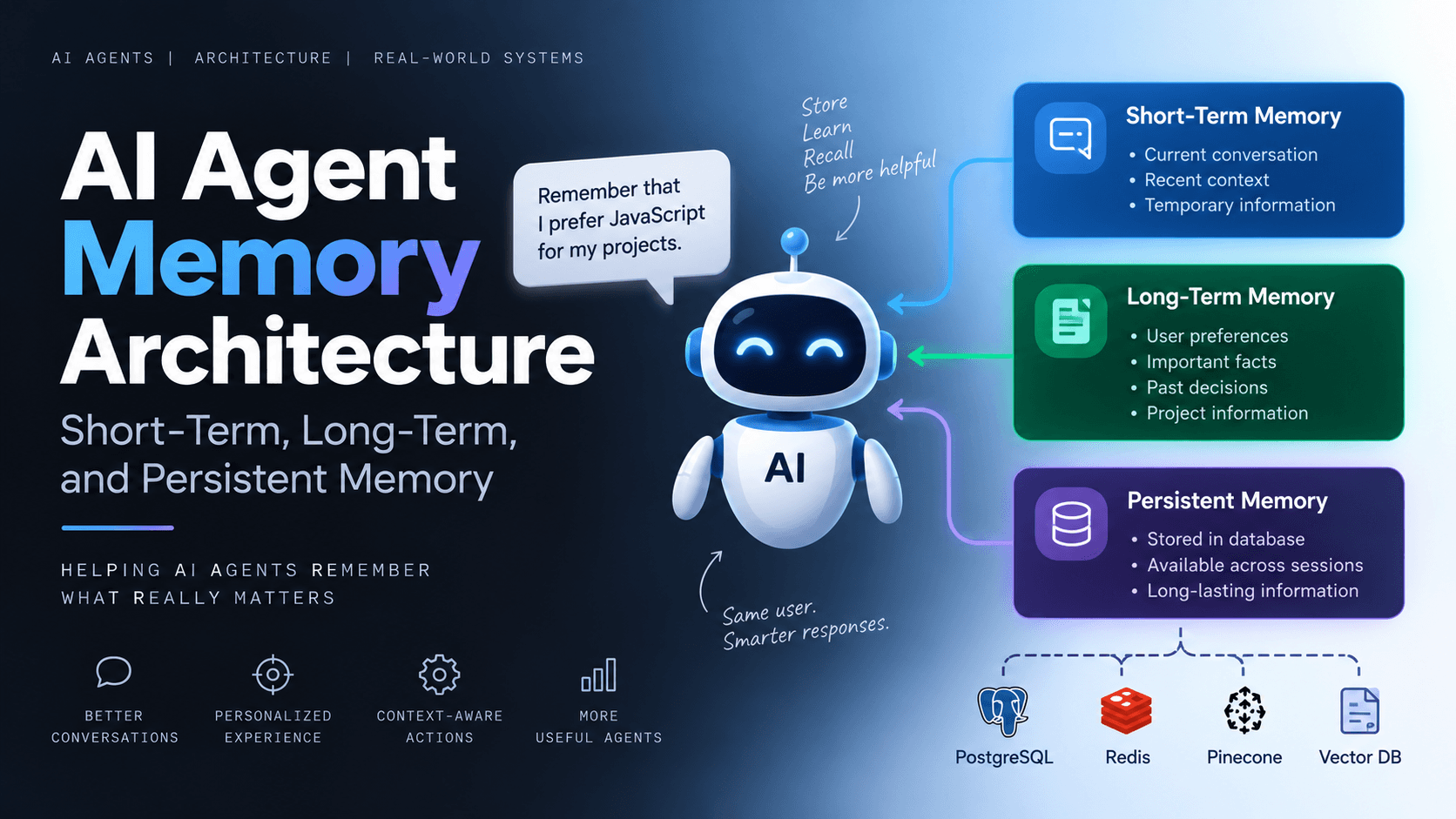
“AI agents need more than just intelligence—they need memory. Explore the architecture of short-term conversational context, long-term vector retrieval, and persistent storage that enable agents to remember across sessions.”
AI agents are becoming more useful because they can do more than just answer questions. They can search the web, use tools, access databases, and complete tasks.
But there is one critical problem:
How does an AI agent remember what happened before?
If every conversation starts from zero, the agent has no idea who the user is, what they discussed earlier, or what preferences they have.
This is where AI agent memory comes in.
What Is AI Agent Memory?
AI agent memory is the mechanism that allows an agent to store and use information from previous interactions.
A simple architecture looks like this:
  ↓
AI Agent
  ↓
Memory Layer
  ├── Short-Term Memory
  ├── Long-Term Memory
  └── Persistent Storage
The important thing is that different types of memory are useful for different situations.
1. Short-Term Memory
Short-term memory contains information from the current conversation or task.
Example Scenario:
- User: My name is Shubham.
- Agent: Nice to meet you, Shubham.
- User: What is my name?
The agent can answer because the previous messages are still part of the current context.
It usually looks like:
User Message
  ↓
Conversation History
  ↓
AI Agent
  ↓
Response
Short-term memory is useful for:
- Current conversations and immediate dialogues
- Multi-step tasks and chain-of-thought workflows
- Recent tool invocation results
- Temporary context and ephemeral state
The limitation: It doesn't work well for very long-term information due to finite context window boundaries.
2. Long-Term Memory
Long-term memory stores information that should be available in future conversations.
Example Scenario:
- User: "I prefer JavaScript and usually work with Node.js."
- Memory Store: User prefers JavaScript · User works with Node.js.
Later, the agent can retrieve this information when needed.
A simple flow is:
  ↓
AI Agent
  ↓
Search Memory
  ↓
Relevant Information
  ↓
LLM
  ↓
Response
Long-term memory can store things like:
- User preferences and interaction styles
- Previous architectural decisions
- Important domain facts
- Project repository information
- Frequently accessed context and summaries
3. Persistent Memory
Persistent memory means the information remains available even after the conversation ends.
Example Scenario:
- Monday: User → "I am building a Node.js application."
- Wednesday: User → "Help me improve my application." → Agent retrieves previous information.
The agent doesn't need to start from scratch. This information can be stored in SQL/NoSQL databases, vector databases, or key-value stores depending on the use case.
A Simple AI Agent Memory Architecture
A practical design looks like this:
                      ↓
                  AI Agent
                      ↓
        ┌─────────────┴─────────────┐
        ↓                           ↓
   Short-Term                   Long-Term
     Memory                      Memory
        ↓                           ↓
   Conversation                Vector DB /
     Context                    Database
        └─────────────┬─────────────┘
                      ↓
                     LLM
                      ↓
                   Response
The agent first uses the current conversation and then retrieves older information when necessary.
Why Memory Matters
Without memory, every interaction is isolated.
With memory, an agent can become much more useful.
For example, a personal AI assistant could remember:
- Name: Shubham
- Role: Software Engineer
- Preferred language: JavaScript / TypeScript
- Current project: AI Agent Platform
The next time the user asks something related to the project, the agent can use this information instead of asking the same questions again.
Final Thoughts
Memory is becoming an important part of AI agent architecture. An agent doesn't just need a good model. It also needs the right context at the right time.
- Short-term memory helps with the current task.
- Long-term and persistent memory help the agent understand information from previous interactions.
The real challenge is not storing everything. It's deciding what is worth remembering and when that information should be used. That is what makes memory an important part of building reliable AI agents.

Related Articles
MCP Is Becoming the API Layer for AI Agents
AI agents need a standard way to connect with tools, data, and services. Explore how MCP could become an agent-facing layer alongside REST APIs, databases, SaaS platforms, and internal systems.
Engineering Secure AI Agents: Permissions, Sandboxing, and Zero Trust
As AI agents gain access to APIs, databases, files, and external tools, security becomes paramount. A practical guide to least-privilege permissions, runtime sandboxing, Zero-Trust architecture, secrets protection, human-in-the-loop approvals, and continuous auditing.
Understanding Google’s A2A Protocol for AI Agent Communication
Learn how Google's Agent-to-Agent (A2A) Protocol enables AI agents to securely communicate, collaborate, and exchange tasks across different frameworks and platforms in the multi-agent era.