
WebMCP Explained: The Future of AI-Friendly Websites
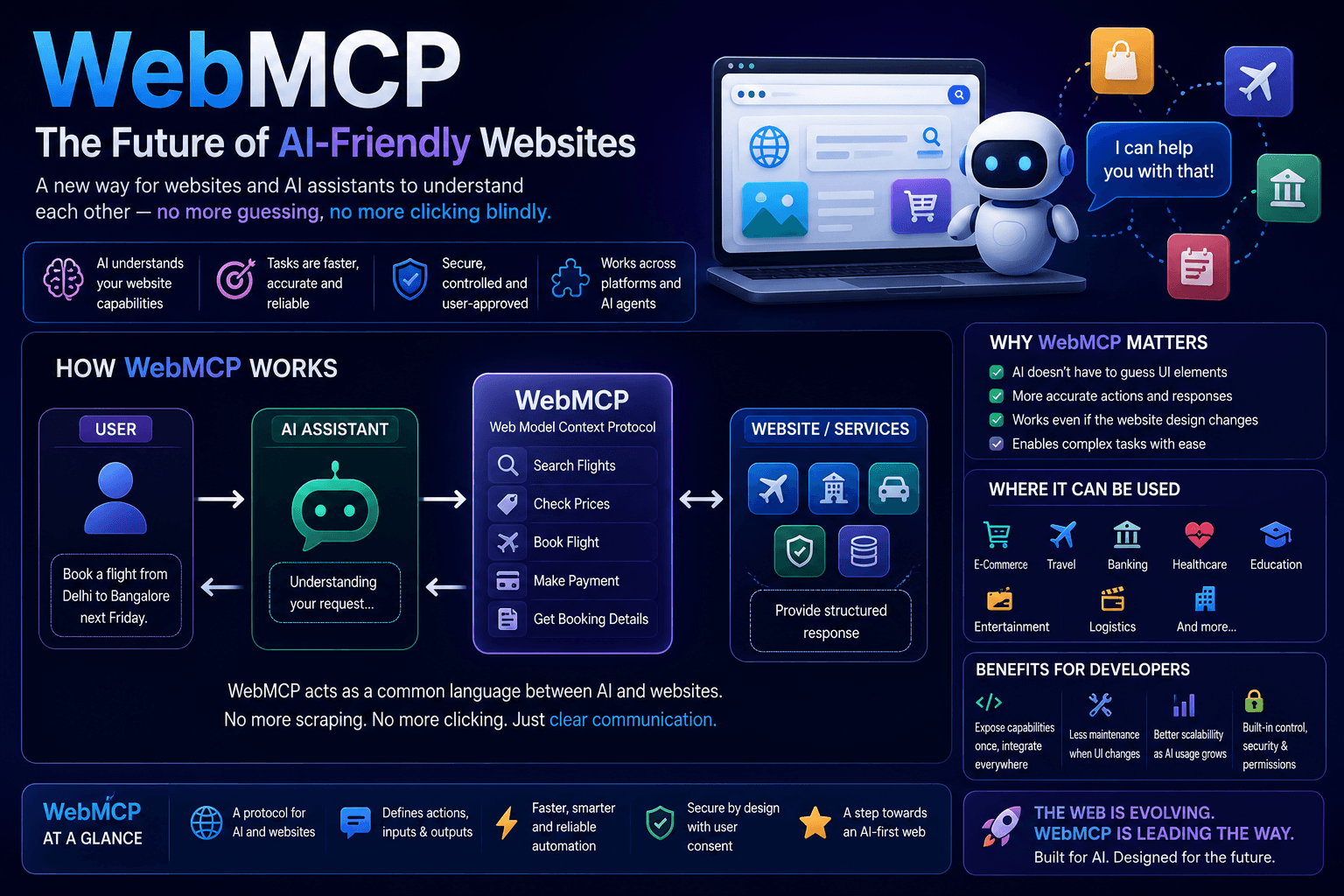
“What if websites could communicate directly with AI instead of forcing AI to guess what every button and page does? That’s the idea behind WebMCP.”
Introduction
Artificial Intelligence is changing the way we interact with the internet. Instead of manually searching websites, users are beginning to rely on AI assistants to complete tasks.
Imagine saying:
“Book me the cheapest flight from Delhi to Bangalore next Friday.”
Or:
“Find me a gaming laptop under INR 80,000.”
Today’s AI assistants can attempt these tasks, but they usually have to navigate websites just like a human — clicking buttons, reading HTML, and figuring out different page layouts. Since every website is built differently, this process is slow and unreliable.
This is where WebMCP comes in.
What is WebMCP?
WebMCP is an emerging approach that aims to help websites expose their capabilities in a way AI assistants can understand more easily.
Instead of making AI understand webpages visually, a website can directly tell the AI:
- What actions are available
- What information is required
- What response it will return
Think of it as a common language between websites and AI.
Rather than guessing where a “Book Now” button is located, the AI simply knows that the website supports a Book Flight action.
Why Do Current Websites Make Things Difficult?
Today’s websites are designed for people, not AI.
When an AI wants to complete a task, it often has to:
- Read HTML
- Understand page layouts
- Find buttons
- Fill forms
- Click through multiple pages
If the website changes its design, the AI may stop working correctly.
This is one of the biggest challenges with browser automation tools like Selenium and Playwright — they depend heavily on the website’s user interface.
How WebMCP Solves This Problem
Instead of exposing only webpages, a website can expose its capabilities.
For example, an online shopping website could provide actions like:
- Search Products
- View Product Details
- Compare Products
- Add to Cart
- Checkout
- Track Order
Now, when a user asks:
“Find the best wireless headphones under INR 5,000.”
The AI doesn’t need to search the webpage visually. It simply calls the Search Products capability and receives structured data, making the interaction much faster and more reliable.
WebMCP vs Traditional APIs
You might wonder:
“If APIs already exist, why do we need WebMCP?”
Traditional APIs are built mainly for developers. Every API has different endpoints, authentication methods, and documentation, which means AI systems often require custom integrations for every website.
WebMCP focuses on making websites easier for AI to understand by exposing capabilities in a more standardized way.
A good analogy is USB.
Before USB, every device needed a different connector. USB introduced a common standard that simplified communication between devices.
WebMCP aims to do something similar for AI and websites.
Where Can WebMCP Be Used?
WebMCP has the potential to improve many industries:
- E-commerce: Search, compare products, and complete purchases through AI.
- Travel: Book flights, hotels, and rental cars using simple natural language.
- Banking: Check balances, review transactions, or transfer money securely.
- Healthcare: Schedule appointments and access medical reports.
- Education: Enroll in courses, download study materials, and track progress.
As AI assistants become more capable, these interactions could become part of our daily routine.
Benefits of WebMCP
For users:
- Faster interactions
- More accurate results
- Better AI assistance
- Less manual navigation
For developers:
- Easier AI integration
- Less dependence on browser automation
- Reduced maintenance when website designs change
- Better scalability for future AI applications
Challenges
Like any emerging technology, WebMCP still faces several challenges:
- Strong security and authentication
- User permission management
- Privacy protection
- Industry-wide adoption
These issues will need to be addressed before WebMCP becomes widely used.
Is WebMCP the Future?
Although WebMCP is still in its early stages, it represents an important shift in how websites and AI may interact in the coming years.
As AI assistants move from simply answering questions to actually completing tasks, websites will need a more reliable way to communicate with them.
WebMCP provides a foundation for that future.
Final Thoughts
The web has evolved many times — from static webpages to mobile-first design and powerful APIs.
Now, we’re entering the era of AI-first experiences.
Instead of AI trying to understand websites like a human, websites can finally communicate with AI in a structured and reliable way.
WebMCP isn’t just another web technology — it represents a step toward a future where AI assistants can interact with websites more intelligently, securely, and efficiently.
If AI continues to become part of our everyday lives, technologies like WebMCP could play a major role in shaping the next generation of the internet.
If you enjoyed this article, follow me on Medium for more content on AI, DevOps, Cloud, and Software Engineering.

Related Articles
MCP Is Becoming the API Layer for AI Agents
AI agents need a standard way to connect with tools, data, and services. Explore how MCP could become an agent-facing layer alongside REST APIs, databases, SaaS platforms, and internal systems.
AI Agent Memory Architecture: Short-Term, Long-Term, and Persistent Memory
AI agents need more than just intelligence—they need memory. Explore the architecture of short-term conversational context, long-term vector retrieval, and persistent storage that enable agents to remember across sessions.
Engineering Secure AI Agents: Permissions, Sandboxing, and Zero Trust
As AI agents gain access to APIs, databases, files, and external tools, security becomes paramount. A practical guide to least-privilege permissions, runtime sandboxing, Zero-Trust architecture, secrets protection, human-in-the-loop approvals, and continuous auditing.